Thoughts of the Day: July 16, 2026

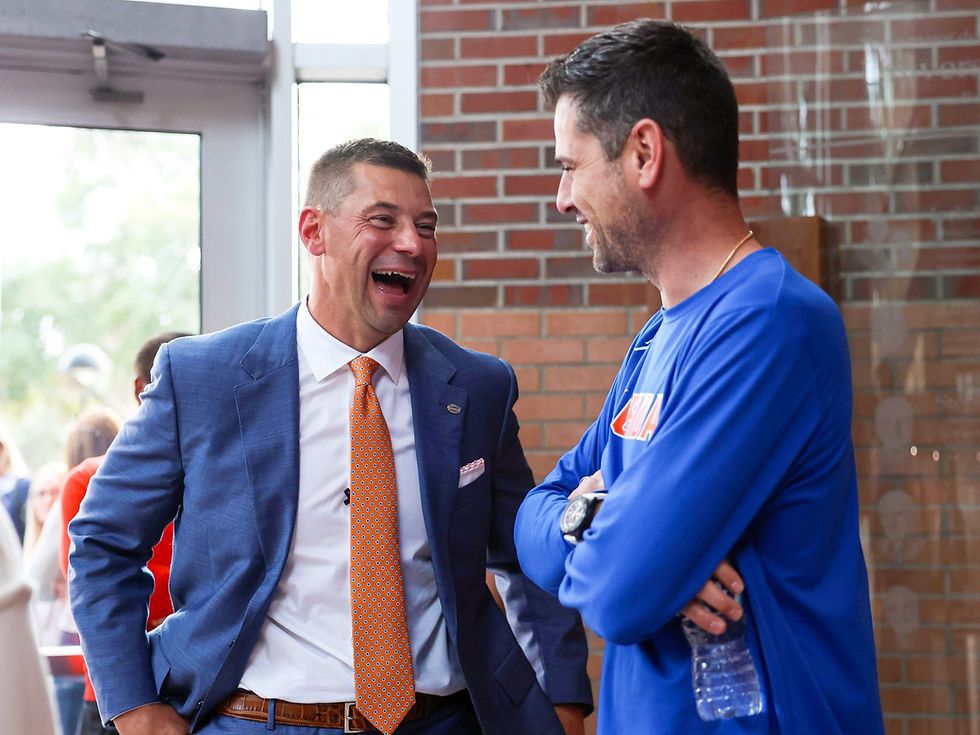
A few thoughts to jump start your Thursday morning:At Atlantic Coast Conference Media Days in Charlotte Wednesday, Ashton Daniels, whose quarterback journey has taken him from Stanford to Auburn to Florida State, said, “We’re going to get this place (FSU) back to where it needs to be. It’s just going to take time.”
Time is precious and in short supply in Tallahassee where FSU has posted six losing seasons in the last eight and is 7-17 in the last two. Another losing season in 2026 and FSU might put out a Bat Signal to its alumni and boosters to hold bake sales and car washes profitable enough to raise the $51 million it will take to send HBC Mike Norvell on his way.
Norvell isn’t the only coach in the country on the hot seat but the enormity of his buyout may offer a measure of protection most others lack. He’s actually a pretty good football coach but like every coach in Division I he’s under a win now or else mandate. For years there was this unwritten rule that a head coach had five years to get his program established as a consistent winner, but as coaches’ salaries continue to increase exponentially so does the demand to win now.
Jon Sumrall made it perfectly clear on the day he was hired as Florida’s football coach that he understood the clock is ticking and he is expected to produce an immediate winner. Sumrall is Florida’s fifth football coach since 2011. The previous four had multi-year deals but never made it past year four before they were fired.
“I respect the Florida fan base is not patient,” Sumrall said at his first UF press conference. “They want to win right now, too. You’ve got the right coach. I’m wired that way. I’m not comfortable having a plan to win in eight years. I want to win tomorrow.”
Sumrall signed a six-year deal with a starting salary of $7.45 million to coach the Gators. That’s more than double what he made last year at Tulane, which won the American Conference championship and made it to the College Football Playoff. Sumrall went 12-2 his first year at Troy (2022) then followed that up with an 11-2 second season. His first year at Tulane produced a 9-5 record followed by the 11-3 mark in 2025. He’s won three conference championships (two at Troy, one at Tulane) and played for the conference championship (Tulane) the other year.
Since taking the Florida job, Sumrall has been a positive, enthusiastic CEO of the Florida football program. His confidence has contagiously carried over to the Florida fan base. Just a week before Sumrall speaks at SEC Media Days in Tampa and a little more than two weeks away from the start of fall practice, there is a noticeable uptick in a fan base starved for a winner. In a little more than half a year, Sumrall has neutralized the negativity that comes from four losing seasons in the last five and six since 2013 for a program that went 33 straight years without posting a sub-.500 record.
“I’m built for this job,” Sumrall said months ago. “I was made for this job. Winner’s win. I’m a winner. We’re going to win.”
He is on the clock but seems unfazed by the pressure. Something about Jon Sumrall makes it easy to think his own personal coaching history is about to repeat itself. They might be scrambling for buyout money just in case at what Urban Meyer dubbed “the school out west” but if Sumrall produces a winner immediately, the $7.45 million he’s being paid will seem like a bargain.
FOLLOW THE MONEY
Auburn, which has moved its season-opener with Baylor to Atlanta’s Mercedes-Benz Stadium, has entered into a lucrative NIL agreement with the Aflac Kickoff Game. As many as 24 Auburn athletes will enter into third party deals to market and promote the game. The Peach Bowl, which is the sponsor of the game, is hoping deals like this will help convince future teams to move games to neutral sites.
Beside the NIL money, Auburn will be compensated for moving a game from Jordan-Hare Stadium 108 miles up the road to Atlanta. The game will be nationally televised, which is good for Auburn’s exposure but taking the money involves a tradeoff. It’s good for Auburn’s bottom line, but local businesses that count on football weekends to stay in the black will lose a weekend of revenue and Auburn fans lose a home game. Since Jordan-Hare seats 87,000 and Mercedes-Benz Stadium seats 71,000, thousands of fans will lose an opportunity to see Auburn play in person.
Weighing the adverse effect on the community and season ticket holders with its athletic department finances, Auburn AD John Cohen said, “The challenge that we have is we also have to be extremely competitive for third-party marketplace for NIL … We have to get great, quality student-athletes.”
Home games have always been sacred but this is a brand new era of college sports in which athletes are paid but there is no salary cap and the guardrails currently in place are at best inadequate. To know where college sports are headed just follow the money and brace yourself. It is only a matter of time before corporate sponsorship patches make uniforms look like soccer jerseys are the norm.
Imagine the Publix Gators playing the Chico’s Bailbonds Bulldogs in Jacksonville in a World’s Largest Outdoor Cocktail Party sponsored by Grey Goose Vodka. It might happen sooner than you think.
MORE LAWSUITS AHEAD FOR NCAA
Earlier in the week eleven athletes from four different sports filed a class action suit against the NCAA in Federal Court in Colorado, all of them challenging the NCAA’s new 5-for-5 legislation that failed to grandfather in fourth-year seniors who are excluded from a fifth year of eligibility. More than a week ago a judge in Cincinnati granted an injunction for 16 basketball players who took the NCAA to court after being denied a waiver that would make them eligible.
In a statement on behalf of the 11 in Colorado, attorney Rob Shelquest said: “These athletes aren’t asking for special treatment. They’re asking to not be singled out and excluded from the NCAA’s eligibility framework. The NCAA updated the rules but refused to apply them only to the very group that was most immediately affected. If the NCAA has determined that five years of eligibility is the fair rule for college athletes, then athletes who would still be eligible but for completing four years of eligibility should not be deprived of the same educational, athletic and NIL opportunities.”
Bet the farm that this lawsuit is the tip of the proverbial iceberg. With the 2026-27 athletic year set to begin on a wholesale basis in 52 days when college football kicks off, we can expect hundreds and perhaps thousands of athletes to lawyer up to take on the NCAA for injunctive relief that overrules the 5-for-5 legislation. The NCAA, in its infinite wisdom, could look back on dozens of lost court cases and say no more. That would be the prudent and intelligent thing to do, but can anyone recall when the NCAA actually did the smart thing and compromised?
It would be so simple to compromise rather than waste millions of dollars in legal fees while taking a beating in one courtroom after another. The NCAA has vowed to appeal the Ohio case and continue fighting any new cases. In its statement following the loss in Ohio, the NCAA said: “Giving those student-athletes another season would destabilize rosters just ahead of the coming season by disrupting settled expectations of countless student-athletes regarding their expected roster spots and playing time next year, including incoming freshmen who are eager to participate in the life-changing experience of college athletics.”
Side note: Denzel Aberdeen is the only Gator athlete known to be considering taking on the NCAA in court. He has filed the paperwork necessary for a waiver with a decision any day now. Should the NCAA reject his waiver request, Aberdeen is prepared to take his case to the courts.
ONE FINAL PITHY THOUGHT: During the past few weeks I have probably watched as many or more soccer matches than I have in my entire 74-plus years. I can’t say that seeing all these World Cup matches has changed my mind about the game – I still don’t like it nor do I anticipate a time when the game will grow on me enough to enjoy it. My reasons for disliking the game are numerous and while I don’t qualify as an expert, I’m far from a novice when it comes to understanding it.
While I may find soccer rather boring, this World Cup has given me an appreciation for two things – (1) the passion of fans from all over the world who live and die with their country’s team every four years; and (2) the greatness of Lionel Messi.
The World Cup is a magnet that brings in millions of fans from every corner of the globe to the country – countries in the case of the current World Cup which staged matches in Canada, Mexico and the United States – in which the spectacle unfolds over the course of several weeks. To World Cup fans, each match is a celebration in which the competition taking place on the field is matched by the competition among fans who fill the stadiums. They sing, they dance, they yell, they scream and they cry tears of joy when they win and advance to the next round, tears that represent the heartbreak of an entire country when they lose.
Perhaps it is because the World Cup takes place only once every four years that it brings out such fanatic intensity from the fans. They save their money for years in advance with the hope of spending a month in a foreign country watching their national team, first in group play, then in the knockout round where it’s win and move on, lose and go home.
If the fans are fortunate then they may have occasion to behold true greatness. I’ve been writing about sports professionally for more than 60 years. Experience has taught me to recognize greatness when I see it no matter the sport. When it comes to soccer or any sport, Lionel Messi has an it factor that is off the charts. Whatever it is, Messi has it in abundance. He’s not very big (5-7) and not very fast, probably because at 39 his illustrious career is winding down. Physically he looks quite ordinary but watching him play is the soccer equivalent of watching Michelangelo paint the ceiling on the Sistine Chapel. He is a soccer savant.
Wednesday in Atlanta in Argentina’s World Cup semifinal win over England, Messi was denied scoring opportunities by an English defense determined that if it lost, it wouldn’t be because Messi found the back of the net with his foot. No problem. Messi showed he is every bit as adept passing the ball as he is scoring goals. In the last five minutes of regulation he assisted with a corner kick, then in extra time delivered a spectacular pass that found the head of a teammate, who knocked the ball past the English goalie for the game-winner. Truly great players in any sport save their best for the games and moments that mean the most and Messi delivered, practically willing Argentina to the World Cup championship match against Spain Sunday.
The match with Spain will probably be the final time we see Messi in the World Cup. I haven’t a favorite team for this championship match, but I do have a favorite player. If this is the last time I’ll see Messi in a World Cup match, then I watch, hoping he goes out in a blaze of glory, leaving one last indelible mark on the game.


Part of the NCAA’s legal troubles stem from its handling of eligibility post-2020’s Covid year. So the governing body made all sorts of allowances in the five years afterward, even a few more now. Allowing four-year athletes one more go for 2026-27 would create some roster imbalances, but likely not having widespread on competitive outcomes. The lack of applying its own rules over many years has caught the NCAA in the legal thistles. The organization needs to just give up and live with the consequences this year.