Camp Napier At The Midway Point: "We Need Players"


The situation at tight end tells you a lot about where the Florida Gators are midway through their first spring practice under new head coach Billy Napier. Thursday was the eighth practice of the spring and the first scrimmage. Injuries have taken such a toll – Jason Odom and Nick Elksnis are done for the spring and Gage Wilcox is done for his career – that Napier has only two scholarship tight ends available.
It is a situation that has required some creativity on the part of the Florida coaching staff and the willingness of players on the roster to do what is best for the team just so the Gators can hold a scrimmage.
“We’re thin there,” Napier said, describing the situation at tight end. “A long snapper caught a pass today and Big Griff (Griffin McDowell) caught a pass today. If that gives you any indication. We’ve got two defensive tackles that are over there. We’ve got a long snapper just taking reps.”
One man’s injury is another man’s opportunity. Answering the call at tight end is Dante Zanders. Recruited as a tight end out of Boca Raton, he spent the 2018-19 seasons as a backup before switching to the defensive line in 2020.
He bulked up to 287 when he was playing inside on the D-line, but dropped down to 261 to be more of a hybrid defensive end/tackle this spring. He’s done so well at tight end that he may have made a permanent alteration to his future at UF.
“There’s no question in my mind that not only is he going to be able to play but he’s going to be able to do his job,” Napier said. “He has been a godsend to some degree, relative to his ability. He’s really bright. He’s picked it up quickly. He’s able to go out there and execute.”
Tight end isn’t the only position where attrition and injuries have taken their toll. The Gators are banged up at safety and they’re woefully thin at inside linebacker.
Due to insufficient numbers Thursday, Napier admitted there were 25-30 plays he wanted to run in the scrimmage that he couldn’t. Even though the plays were cut back, it was still important to get the scrimmage in. Now there is film and a chance to evaluate, teach and correct ahead of Saturday’s practice.
“We’re lucky,” Napier said. “We’re just a couple players away here from not being able to practice the way we want to. When a long snapper catches a pass, you’re being creative to find a way to get it done.”
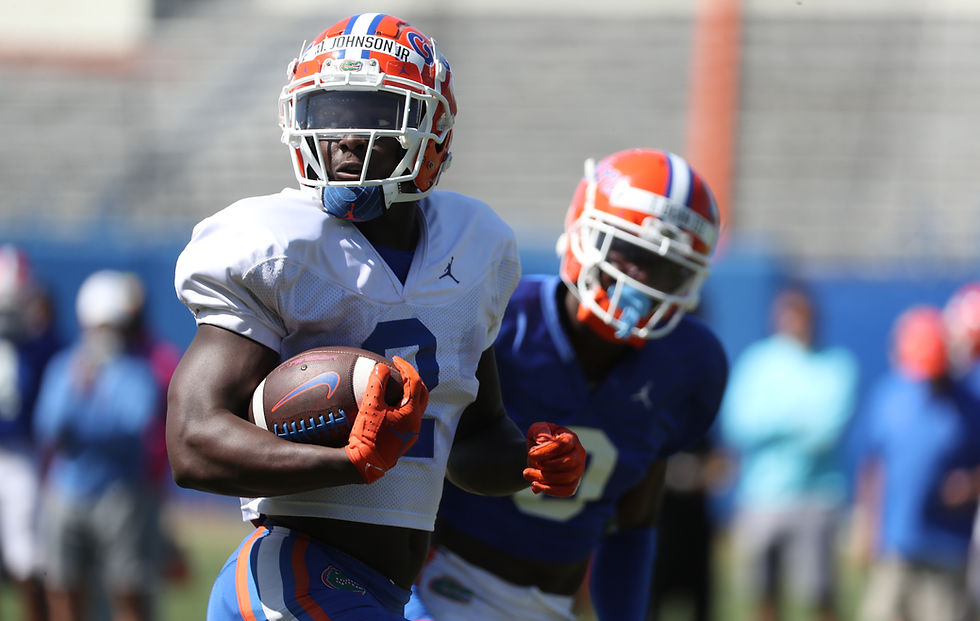
This is the midway point of Camp Napier. The new head coach is pleased with attitudes, pleased with hustle, pleased with the overall learning curve although like any coach he’d like to see improvement in all these areas. Those things are correctable.
What isn’t correctable – at least for the remainder of the spring – is having enough able and experienced bodies to work with. Napier has enough good and experienced players for a first team. When you dip below the 28-30 player mark, the numbers aren’t sufficient and the experience is inadequate.
Third team? What’s that?
“We don’t have a third group right now if that makes sense,” Napier said. “We got a first and second group. It basically eliminated the third group. We got a lot of players who are taking advantage of opportunities. With challenges comes opportunity. You can sit around and complain about those things but to me, I see opportunity. That’s the approach we’re going to take.”
Napier isn’t one to complain, but he does live in the real world. Having coached at Clemson under Dabo Swinney and at Alabama under Nick Saban, he understands that there isn’t a tremendous amount of difference in the top 22 talent at most schools in the SEC. Just about every team has at least one very talented player at each position on both sides of the ball. It’s what happens when you rotate in that second group that you see the disparity. The really good teams in the SEC like Alabama and Georgia can roll out three teams on either side of the ball, almost all of them former four and five-star recruits.
Florida doesn’t have that. The Gators probably have 30 players with enough experience to perform at a high level in the Southeastern Conference, which would have been plenty if we still lived in the era of single platoon football. In the modern era where the players are bigger, stronger and faster than they’ve ever been injuries take their toll. Players rotate in and out of games based on situations and circumstances. The good teams have at least 44 very good players ready to go at all times and they should be backed up by at least 22 more who are developing rapidly.
It's just spring football and Napier’s first spring to boot, but that doesn’t change the fact the Gators don’t have enough good players to the point that five walk-ons are going to go on scholarship this spring. He shudders to think where the Gators might be this spring without the contributions of transfers. There will be more.
“We took over a program, we've had a number of things that have caused attrition on our team,” Napier said. “I mean, we're literally going to give five walk-ons scholarships this spring. So, we have spots available. So, the University of Florida, you can anticipate us being very aggressive in the portal this spring. We need players. Now, I think the approach is going to be, you know, acquire as many good players as we can at any position, right? So, you know, we're thin and we need help in a lot of different spots. So, I think we have, we're approaching double digits if that makes sense.”
Building a roster through the transfer portal isn’t the ideal way of doing things but it is a tool that Napier has at his disposal until he can establish a recruiting pipeline that every year brings in enough players to make the portal necessary only for a couple of plug and play types. That Napier might be adding 10 or more transfers from the portal in the next few weeks says plenty about inadequate recruiting under the previous head coach.

If there is a model to go on for how to restock a roster through transfers, it belongs to Napier’s buddy Mel Tucker, the head coach at Michigan State who went from Big Ten doormat to a New Year’s Six bowl team by picking and choosing well from the portal. Tucker brought in 21 transfers, six of whom started including Kenneth Walker III, who finished second in the nation in rushing.
Napier wasn’t unprepared for a roster shortfall when he was hired by Florida athletic director Scott Stricklin back in December. One of the genuine appeals of Napier was his whole program approach. Call it an anticipate the problem before it exists type of approach. It’s all part of changing the culture of the entire football program.
Napier promised “an army” of support staff and analysts who are dealing with everything from recruiting high school kids to personnel issues to things like food, housing, academics and parking tickets (huge problem that has since been solved). The Gators now have an entire department devoted to the transfer portal. Not only do they study players who enter their names in the portal to determine if they would be good fits at Florida, they study players on existing rosters to know which ones might be worth pursuing should they elect to transfer.
“I think culture's all about people, right?” Napier said. “I think when you get put in these leadership positions you realize pretty quickly you need to surround yourself with really good people and we're very fortunate that our administration gave us the resources to go hire the absolute best. We hired people that have an authentic care for the players and are experts at what they do. Those people coming to work each day, they do their job, we establish trust. I think there's great communication. We're still a long way off, but I think what I do see is a few more guys smiling, you know? Few more guys enjoying their experience. I see a little bit better discipline with their accountability. You know some of these lists that we have are shrinking in terms of issues on our team. And I'm very thankful for the players, right? Because I walked in the door and they don't know me from Adam. They gave us a chance and we're going to work hard every day, continue to earn their trust and their respect."
When he was hired, Napier talked about making the Florida football program a life-changing experience for the players and for the people who make up the organization. Thursday he pointed out that the 100 or so players that make up the Florida roster are supported by approximately 250 on the staff. It may seem like a staggering number, but Napier is determined to make certain Florida players have everything they need to be successful as people, in the classroom and on the football field.
It's all about putting people first.
“I think as a competitor and as a person who cares for the people around you I think that's something we can control, right?” Napier said. “So we control the quality of the experience of the players at the University of Florida. It's a decision that we make, right? So there are no excuses here. I think that the food is just one example of a lot of things that we can continue to try to get better at. I think that the experience of the player is the most important thing, right, relative to we're trying to create life-changing impact as an organization – the person, the student and the football player – and there’s certainly a nutrition/performance component to the food, but there's also just a customer service aspect to it. These guys work extremely hard. I don't think people can comprehend the amount of time and effort that they've put into their role and how they represent this place. So they're working hard as individuals, but they represent something bigger than just themselves. The least we can do is feed them a good meal at every opportunity."
There are still seven practices, another scrimmage next week and a spring game on April 14. Progress has been made but injuries and attrition have limited what Napier wanted to accomplish. He isn’t unhappy with the effort he’s getting but the lack of players tells him just how much work still has to be done.
“We just need repetitions,” Napier said. “We’ve gotten a lot so far. We need more. I don’t think I’d ever stand up here and say that’s not the case. This is college football. It’s a developmental game and you’ve got a new team every year. We’re going to work on ways to solve the problems that we do have and make the best of each situation and go play a brand of football that fits this team and the dynamics within this team.”


Comments