It's About The Discipline; No Gray Areas Allowed


By FRANZ BEARD
GatorBaitMedia.com
To the casual observer, Billy Napier is probably the ultimate control freak. He’s got every second of his every day planned out. He has a purpose in everything he does, in everyone he has hired, in every interaction with one of his players. There is a right way of doing things and there is a wrong way to do things. Players are expected to do the right thing all the time.
There is no gray area.
“The gray area is the enemy,” Napier said Tuesday at Florida’s media day prior to the opening of fall camp. “That’s what I would tell you. We want to have very structured routine process for our players. I think players develop confidence from that. I think routine and great preparation, that breeds confidence. When I know what to expect, I execute my plan.”
There is a reason for eliminating the gray areas. He doesn’t want players in limbo. He wants them to see things clearly so they can make the right decision. Right decisions, Napier believes, make for better people. Better people make better football players.
In simplistic terms, Napier sets the following standard for his players: (1) Committed to being good students who go to class and do the work assigned to them; (2) have an unwavering goal of earning a meaningful college degree; (3) make it a point to become better every day in every way; (4) be a better teammate; (5) be a better friend to your teammates.
That is a blueprint for being a better person. It is also a foundation for being a better football player. If the hearts and minds of the players are won, it will carry over to football and the players will put in the hard work to be the best football player possible.
Shrinks and analysts might say this is a tough love approach. Offensive line coach Rob Sale says it’s an approach that works.
“A player will run through a wall for you if they know that you care about him,” Sale says.
Care begins with discipline. It could be argued that the previous coaching staff cared about the players, but for reasons unknown there was no demand for discipline, and it showed in the loss column.
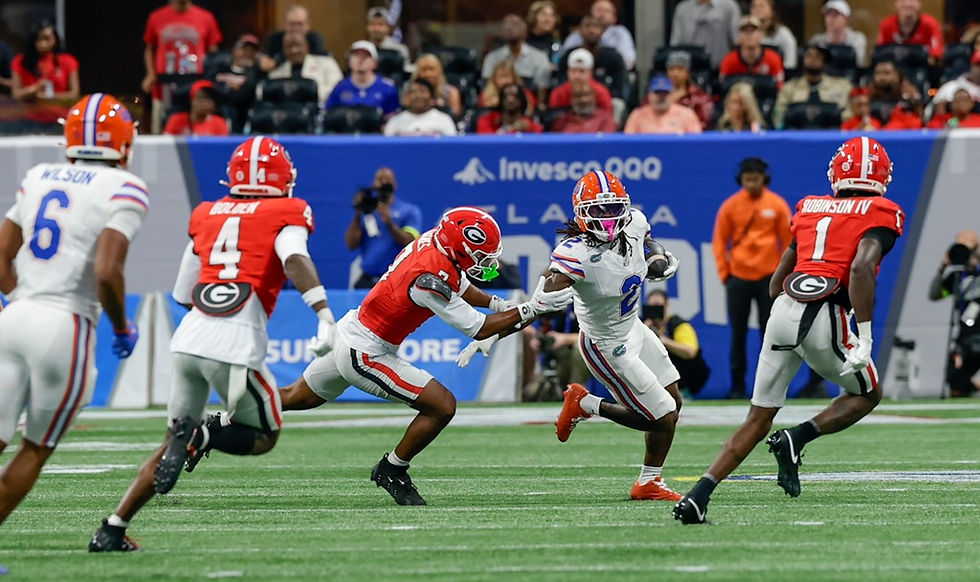
Go back to 2020. There was “Shoe-gate” when the LSU game turned on a dime when Marco Wilson picked up the shoe of an LSU player and heaved it. The ensuing 15-yard penalty extended the drive that led to a game-winning 57-yard field goal. A week later in the SEC Championship Game in Atlanta, an offside penalty helped Alabama score its first touchdown of the game. On a play in which the defense got an incomplete pass on third down there was a personal foul that gave Bama a first down that led to a touchdown. Bama went up 28-10 in the first half because Kyree Campbell eased up before he got to the sideline. There was a substitution infraction that nullified a good play by the defense on third and eight. Instead of forcing a long field goal, Bama had third and three which it converted to extend a TD drive. Florida ended up losing the game 52-46.
Last year against Alabama, a missed extra point forced the Gators to go for two in an attempt to tie the game at 31-31. On the two-point attempt, a blown assignment resulted in a missed block and a failed conversion. Florida lost 31-29. Two weeks later against Kentucky, the Gators were assessed 15 penalties, the worst of which was a hold that nullified a 10-yard run by Dameon Pierce that would have given UF a first down on the UK 14. UF had to settle for a field goal attempt that was blocked due to a blown assignment. UK ran it back for what proved to be the game-winning TD. Florida lost 20-13, a game that the defense only gave up one TD.
Things got worse as the season progressed and nearly all of Florida’s problems could be rooted in a lack of discipline. That has to change.
“You got to hold them to a standard and if they don’t do it, if they don’t do what you ask ‘em to do, there’s got to be a consequence,” Florida co-defensive coordinator Sean Spencer said. “The consequence has got to be one such that they don’t want to do it again.
“What you want to try to do is you want to make them try to not want to let their teammates down by failing discipline. I think peer pressure is one of the tougher things that we can do.”
Consequences for a lack of discipline. Peer pressure that results in players being conscientious enough that they refuse to let their teammates down.
That’s what happens with championship-level programs. When it doesn’t happen, you wind up with 6-7 records that cost not only the head coach but all his assistants and much of the program infrastructure their jobs.
Mark Hocke, the new strength and conditioning coordinator who is also Florida’s associate head coach, has more contact with the players than any position coach or even Napier. In the time and space between football season and spring practice, then from spring practice until the opening of fall camp, Hocke and his staff become the coaches who have more personal interaction with the players. They push, they prod, they work the players hard to become bigger, stronger, faster, but it’s more than just transforming their bodies.
There is serious discipline involved. Leaders have to be identified and encouraged to set the example for teammates, especially the younger ones who come to the University of Florida essentially clueless about that to expect now that they’ve graduated high school. Hocke tries to educate players to the fact that their actions are being watched and imitated by teammates.
Everyone, Hocke believes, sets an example. The question is whether it’s the right example or the wrong one. Remember, Napier says it’s got to be one or the other because the gray area is the enemy.
“At the end of the day it really comes down to one’s example,” Hocke said. “Every player can ask themselves – you can ask yourself – is my example worth following? … And, it’s about educating big brother and, really educating ‘em all so that they have a good example to follow and how they really communicate with each other.”
Communication has a real place in discipline matters. We hear all the time the old adage that actions speak louder than words and while there is a measure of truth to it, it downplays the effect words have on individual players and on a team.
Words do matter.
“Players are going to model leadership,” Sale said. “We have a great example in Coach Napier, and then he hired the right people to model that for their individual position rooms. Once players see that, you see how coaches interact with each other, then coaches to players, players to players … you want ‘em to speak the right things, choose your words wisely so they’re going to model the example that we give them.”
In the seven months since Napier took over the Florida program, everything that has been done has led up to this moment in time when preparation begins in earnest for a season that begins in The Swamp on September 3 against 2021 Pac-12 champion Utah. There are questions galore about this Florida football team. The schedule is brutal. The Gators have 44 good players but in the SEC 44 is barely adequate. Is there enough depth? Can the Gators avoid the injury bug? They’ll have to avoid a string of debilitating injuries if they want to improve on last year’s 6-7 record.
During his first couple of years at Louisiana where Napier went 18-10 by winning some games he had no business winning, the key was staying on point with discipline. If the other team was simply better, that was a matter that could be resolved by recruiting better players. The critical element was avoiding the on-field discipline issues that prevented winning games.
The process has been fine-tuned since those first two years. In 2020-21, the Ragin Cajuns went 23-2. Now, no one is expecting the Gators to match those numbers in year one of Napier’s reign, but Napier has a team that may exceed expectations of a 6-6 or 7-5 team if the Gators can master the details.
Little things, Napier believes, add up to big things. The team that has control over the little things is going to do well in handling the big things, and it begins with having the discipline to make each moment count in August.
“As we get going here, I think in training camp it’s almost as if you’ve got to stay present,” Napier said. “You’ve got to treat each opportunity throughout training camp as a very competitive event, whether that’s sleep, what you eat, hydration, each lift opportunity, each recovery opportunity, each meeting, each walk-through, each practice. There are lots of opportunities to improve, to put yourself out there, to get feedback, to make the necessary adjustments.”
Notice how the emphasis was on things that we consider non-football related like sleep, food, staying hydrated, paying attention to absorb everything being discussed in meetings. Improve on the little things, what may seem to be the minor little details, and it will pay off with better performance in practice.
Hocke, for example, wears an Oura ring, which measures sleep quality. All the Gators wear one now.
“They say the best growth hormone is God’s given growth hormone and that’s sleep,” Hocke said. So you have athletes and people who say, ‘What supplement can I take? Hey what protein should I take? All this. And, it’s like, well have you gotten eight hours of sleep? Let’s start there, and then we’ve talked about how hard they’re going to work. Sleep’s going to be really important to recover so you can wake up the next day and push the gas again.”
That’s just a small example of how Napier wants players to control the things they can control. Once again, it’s a matter of discipline, a necessity because during the next 30 days, Napier and his staff have to know who they can count on when foot meets football on September 3.
Players on the team also have to know who they will be able to count on and it goes far beyond what goes on during practice in the hot Florida sun.
“They can improve their fundamentals,” Napier said. “They can improve their techniques. Really big focus for me in terms of galvanizing our team and being a great teammate. What do your peers say about you relative to your role on the team?”
Yes, what do teammates say about other teammates? Do they see a brother out there competing to make the whole team better or do they see someone who has a serious need to replace I and me with we and us?
Better people make better football players and better people in a team setting have a real relationship with their teammates. It can’t be one of these situations that when practice ends, players hearts and minds drift off to other places, leaving teammates behind. There is a bond with good teams, a brotherly bond with the great ones.
Nick Saban raved about his 2020 team that went unbeaten and won a national championship in a COVID year that made everything from workouts to relationships complicated. It was the closeness developed by the team that made the winning so special.
This is what Napier wants to achieve at Florida and it starts with making certain his players are more than just someone who shares a locker room and then pound away at each other on a practice field leading up to games. That’s why he puts such emphasis on teammates bonding with each other.
That envelope is being pushed now that Camp Napier has begun and the countdown to kickoff has begun.
“When you have a relationship with the people that you are competing with, when you know their story, when you’ve had in-depth conversations, when you know what to say to motivate, you can push a button,” Napier said. “I think it’s critical for the leadership on our team going out of your way to connect, to sit with someone you don’t know. We make everybody on the team learn everybody’s name, their hometown. We’ve got little things that we do. We shuffle the deck in the locker room. We pair them. Their roommate for training camp will be somebody that they really don’t know.”
The goal is that when training camp ends and the season begins, there will be a real connection between every player on the team. Starters and non-starters, scholarship players and walk-ons, he hopes, will see each other in a different light and instead of 120-125 individuals they will see each other as parts of something bigger – a real team.
Football is the ultimate team game. In baseball, for example, it’s mano-a-mano when a hitter steps into the batters box. Teammates can’t help him see the pitch nor can they help him drive the ball. If the hitter launches a 425-foot home run to win the game, he did it on his own. In basketball, there is no defense for someone standing at the foul line with a tenth of a second showing on the clock. Make the shot and maybe the team wins. Miss and maybe the team loses. In either case, teammates can’t help.
That’s not so in football. The quarterback who throws the game-winning touchdown pass will get praised in the Sunday morning newspapers and all over the internet, but the QB is useless if the right guard misses his block, or the running back didn’t hear the audible or the wide receiver ran the wrong route. It takes 11 players, all of them focused and carrying out their assignments for that TD to be scored. Sure, one or two players may get all the glory for the big play, but it takes 11 players to make it all happen.
That’s why all the little things count. That’s why Billy Napier seems so obsessed with all the small details. Napier isn’t so much a control freak as he is a coach who has broken down the game into its smallest segments and then figured out how to piece them all together into a formula to turn 120-125 kids into a functioning, capable team that can win football games.
Along the way, Napier does understand that there is a bigger picture. Some might call it the method to his madness. It’s called what happens when football comes to an end.
“I think these things carry over into life after football, too,” Napier said. “That’s one of the great things about the game of football. These things apply in a lot of different settings. It will be a big part of what we do and certainly a big part of our success.”
There are no guarantees for success in football, but having the discipline to eliminate mistakes, to turn players into better people that become better teammates and better football players, makes winning a real possibility. Billy Napier may not win nine or ten games this year no matter how much the fans want it and no matter how hard the Gators work. There could be injuries. Some teams may just have too much talent to overcome. There are hundreds of things that factor into whether the Gator win or lose, but one thing for certain, the foundation for success is being put in place.
Where there is discipline and a team that embraces the hard work and effort, good things can happen.
“They come here to play football,” Hocke said. “They don't always come here to do the conditioning, running, the sprints, the heavy lifting, waking up really early. They don't have a problem waking up and playing in front of 90,000 on Saturday night, but what about at 6 a.m. on Monday morning after the weekend, that's a little bit different waking up for that. But it's doing what you don't necessarily love to do like you love it. And that's what I can say about this team. They're learning to love it and the second you learn to love the hard work is the second you got a chance to separate …”


Comments