Ricky Pearsall Is Florida's X-Factor At Receiver


By FRANZ BEARD
The routine is the same every single morning.
Ricky Pearsall shows up at Florida’s practice facility and with the help of a manager or whoever is available to load the Jugs machine, starts catching footballs fired at him from varying angles. The goal is to catch 100 without a drop.
“You gotta get in 100 catches each time,” Pearsall said Wednesday after practice. “I mean in a row. That's how I look at it. I gotta get 100 in a row on the Jugs machine before I can leave. So if I drop one I got to restart.”
From zero. Drop one pass and Pearsall starts all over again. It forces him to concentrate and see the ball all the way into his hands.
When he was at Arizona State, they fired tennis balls at him with the Jugs machine. It was fun. It was even beneficial but you don’t catch tennis balls on the football field. So, now that he’s here at the University of Florida, it is a minimum of 100 footballs every morning.
He arrives at the Heavener Football Center every morning for breakfast, gets treatment from the trainers at 8 a.m. and then it’s off to catch footballs from the Jugs machine. It is a routine but routines, he knows, serve a real purpose.
“Like (Coach) Napier always says, get your routine together and it will carry you through your week,” Pearsall said.
Routine and work ethic have already paid dividends for the Gators. In Florida’s season opening win over then 7th-ranked Utah, Pearsall and Anthony Richardson connected four times for 67 yards. All four of the catches resulted in a Florida first down, three of them critical on touchdown-scoring drives.
He was precise. He was surehanded. He made the moves that separated him from Utah’s defenders, all things that come from routines and habits that don’t take a day off.
Pearsall says what he does on the field is a direct result of repetition, “Just going out there every day with the same mindset that I’m going to get better at something. I think that's something that is necessary for a receiver to have: to go out in a day and knowing exactly where you’re going to get better at that day. I think I’ve stacked days on days of doing stuff and develop. That’s what I did.”
Pearsall’s reputation for relentless pursuit of improvement was well known in coaching circles and one of the reasons that he was one of the highly sought transfers in the offseason. At Arizona State last year, Pearsall caught 48 passes for 580 yards and four touchdowns while playing for an offensively challenged team that had problems getting into the end zone. The Sun Devils ran the ball well enough, but in their final five games of the season they averaged only 129.2 passing yards per game. Pearsall was the only Arizona State wide receiver who could consistently get open.
Arizona State’s offensive difficulties coupled with pending NCAA issues with the NCAA that forced head coach Herm Edwards to dismiss some of his assistant coaches in an effort to stave off harsh penalties that will come soon enough factored into Pearsall’s decision to enter the NCAA transfer portal. The decision to leave was painstakingly difficult, not only because he was a hometown kid playing for his hometown school, but also because it meant leaving Arizona, the only state he has ever called home.
“Yeah, so it was a big decision for me to actually enter the portal because I'm from Tempe,” Pearsall said. “So it was a really big decision. I mean, I talked to my family and made sure that they would go with it as well as me and then we just decided to do what was best for me.”
Once Pearsall placed his name in the transfer portal, there was far more interest than he could have imagined. Obviously, Pearsall knew he was good and would get a lot of interest, but he was completely caught off guard by how much and where it came from. He knew the West Coast schools would have an interest, but there was plenty from east of the Mississippi River, too.
The morning after placing his name in the portal he was bombarded with phone calls and sales pitches. That went on for an entire week. The one call that stood out the most was from Billy Napier, Florida’s head coach, formerly (2017) the offensive coordinator at Arizona State under Todd Graham.
“Entering the portal, I wasn’t expecting how it went because I've never experienced anything like that before,” Pearsall said. “So when I entered the portal, I woke up that morning and the phone calls and the rest of that entire week … honestly, I was on the phone for the entire time because I wanted to make that right decision.”
Talking to Napier, Pearsall was confident he would be a good fit in Florida’s offensive scheme. He felt confident that he and Anthony Richardson could be a great pass-catch combo and he was enthralled with the idea of playing in the Southeastern Conference. Pearsall has the ability to play at the next level so it’s likely that Napier mentioned the fact that in the most recent NFL Draft, 65 players from the SEC were selected. Only 25 were taken from the Pac-12, the league that Arizona State calls home.
When Pearsall weighed all the factors, what Florida had to offer made the most sense.
“I put all my trust into Billy Napier,” Pearsall said. “He’s a tremendous coach and the things that he had to say, we trusted him and want to be here.”
Napier liked the receivers he inherited and recruited but Pearsall added a dimension that was missing. The Gators have receivers with excellent top end speed but what they don’t have is wiggle. That’s what Pearsall brings to the Florida offense.
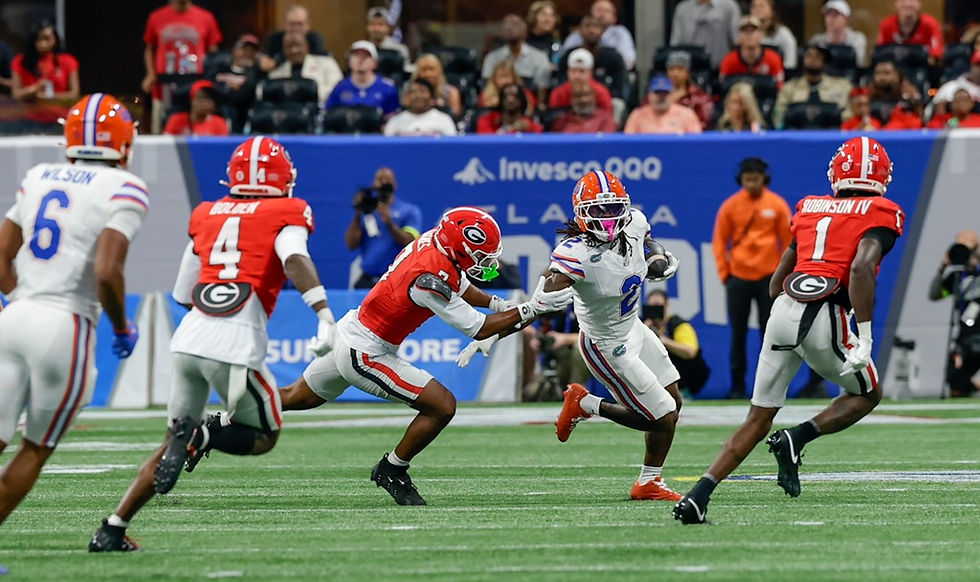
Give him the football with a defender to juke and good things happen. He’s not just a make-you-miss type. Because he has good speed, is a precision route-runner and knows how to read coverages, Ricky Pearsall knows how to find open space in the secondary.
“I think he’s skilled at the line of scrimmage, at the top of the route,” Napier said Wednesday. “He’s got really good ball skills. He’s got a really unique quickness and acceleration. I think he’s got a little creativity. The guy’s been running routes a long time and we needed a player like that, who’s got some run after the catch and some quickness. I think he’s a unique player in the slot who presents a mismatch.”
Pearsall isn’t a small Wes Welker type who specializes in drag routes, bubble screens and simply turning short passes into move-the-chains plays. He’s nearly 6-2 and 195 pounds. The Gators line him up in the slot, but he’s very much a downfield threat as well as a guy who’s going to see his share of the quick outs that allow him to show his duck and dodge skills.
He can run those underneath routes and get yards after the catch the way former UF All-American Kadarius Toney did, but he has the straightaway speed to get into a seam in the secondary for those 14 to17-yard throws that can slice and dice a defense.
In Richardson, Pearsall has a QB who can throw those short and midrange darts but he can also fire it deep.
“If he wants to throw it across the entire field, he can do it,” Pearsall said. “Just ask him. He’ll throw it a hundred yards.”
At nearly 6-2 and 195 pounds, Pearsall is a dilemma for opposing defensive coordinators. Cover him with a corner and chances are Pearsall is bigger and stronger. Cover him with a safety or a linebacker and he can win with his speed. Linebackers? Forget about it.
His productivity will force opponents to bracket him with a pair of defenders and that means other Florida receivers will have single coverage, which Richardson says will make life a whole lot easier.
“He knows how to get open and knows how to run good routes,” Richardson said, adding, “The way he does things is going to help get the other guys open.”
When the Gators were setting passing records in 2020, Kyle Pitts was the matchup nightmare whose presence and productivity opened things up for the other receivers. Pitts was called the “Unicorn” because he was a 6-6, 246-pound tight end with wide receiver speed. Pearsall certainly doesn’t have that kind of size, but like Pitts, he will command so much attention that defensive coordinators are going to have to pick their poison elsewhere.
As the Gators showed in the Utah game, they have a huge, powerful offensive line, three quality running backs and Richardson, the ultimate dual threat QB who can make all the throws and is a go-the-distance threat when he elects to run. Pair him with good receivers and an X-factor like Pearsall and you have the makings of an offense that has the ability to adjust on the fly to take advantage of what the defense is willing to give.
When the Gators play Kentucky this weekend, most experts believe the Wildcats will try to load up the box to stop the run, therefore putting the weight of Florida’s offense on the shoulders of Richardson to win with the passing game. If the Wildcats go eight in the box, Florida’s receivers are going to see either a zone or one-on-one coverage. Either way, Pearsall believes they will be up for the challenge.
“I feel like going into every week, you got to look at it as the receivers are making a big impact on the game,” Pearsall said. “I prepare that way and I expect all the other receivers in the receiver room to prepare that way. Even in the running game, receivers are really impactful with their run blocking and stuff like that. You know what I mean? You know, running back breaks in the second level, you got to be there on your safety; you got to be there on your corner to make big run plays for Trevor, for all those guys. I think every week the receivers can be big.”
No matter what Pearsall and his fellow wide receivers do Saturday night against Kentucky, the routine will be the same Monday morning. Breakfast. Treatment. Jugs machine. Make 100 catches without a drop or start from scratch.
This is very serious business for Florida’s X-factor wide receiver whose dedication to improvement hasn’t changed since he switched from quarterback to receiver as a sophomore in high school.
“Ever since then, just going out there every single day with the mindset of trying to get better at something,” Pearsall said. “You know, one percent [better] every day is what I live by.”


Comments