The Florida Gators Have No Household Names, but A Lot Of Talented Receivers

Updated: Jul 16, 2021

August camp begins in a couple of weeks and time to continue the position-by-position evaluation of the 2021 Florida Gators. The Gators lost the Mackey Award-winning tight end in Kyle Pitts, the highest drafted tight end in NFL history, and fellow first rounder in Kadarius Toney. There are no two individuals who can match the accomplishments of those two heading into the fall, but that doesn’t mean Dan Mullen is lacking weapons and talent.
Here is the breakdown of the 10 scholarship wide receivers and five tight ends on the Florida roster as of July 15, 2021.
WIDE RECEIVERS (10)
Rick Wells (6-1, 204, RSR): Wells is taking advantage of the NCAA ruling that didn’t count the 2020 season against anyone’s eligibility. This will be his sixth season and there are signs of life in his career. After catching just three passes for 27 yards from 2016-19, Wells put together a good second half of the 2020 season to finish with 12 catches for 120 yards. It was enough that the former 3-star recruit out of Jacksonville Raines elected to come back for one last shot at a productive season. Wells doesn’t have tremendous speed but he’s a reliable pass catcher who could be effective as a secondary target and running underneath routes.
Jordan Pouncey (6-1, 212, GR): After transferring in from Texas, Pouncey played in five games last season, catching one pass for 27 yards and a touchdown in the Cotton Bowl against Oklahoma. A 3-star recruit out of Winter Park, Pouncey had offers from Alabama, Georgia. Pouncey doesn’t have great top end speed and will be more of a possession receiver as well as a contributor on special teams. He is a cousin of former Gator All-Americans Maurkice and Mike Pouncey.
Justin Shorter (6-5, 227, RJR): Shorter transferred to UF from Penn State and had a productive first season, catching 25 passes for 268 yards and three touchdowns. His best games were a 3-31 game with a TD catch against Georgia and a 5-94 effort against Vanderbilt. Last year Shorter was used mostly in underneath routes or in the red zone where he could use his physicality to his advantage. This season he expects to be a starter and used more as a downfield threat. At his size, he’s too big for the average corner and he’s faster than the safeties or linebackers he will go against. A former 5-star recruit out of South Brunswick High School in Monmouth Junction, New Jersey, Shorter had offers from Miami, Michigan, North Carolina, Ole Miss, West Virginia and Wisconsin.

Jacob Copeland (6-0, 204, RJR): Could Copeland be this year’s Kadarius Toney? Toney spent three seasons trying to get it all together before breaking out in 2020 to become an All-American and a first round NFL draft choice. Copeland has had two decent seasons (2019-20) but he’s been plagued with inconsistency. The physical talent is there if he can eliminate the drops and become a more precise route runner. Copeland is built like a running back and has exceptional power so, like Toney, he could be Florida’s jet sweep and reverse guy. He should be a serious downfield threat in 2021 after last season when he caught 23 passes for 435 yards and a team leading 18.91 yards per catch as well as three touchdowns. Copeland caught 21 passes in 2019 for 273 yards and two touchdowns. He was a 4-star recruit out of Pensacola Escambia where he received offers from Alabama, Georgia, Clemson, Miami, Michigan and Ohio State among others.

Trent Whittemore (6-4, 213, RSO): There will be comparisons to Chris Doering. Like Doering more than 25 years ago, Whittemore is tall, lanky, local (Gainesville Buchholz) who was a multi-sport star athlete prior to UF who wasn’t heavily recruited (Doering walked on; Whittemore earned a scholarship). And, like Doering who broke in quietly as a redshirt freshman, Whittemore showed plenty of promise in his first year on the field. Whittemore caught 10 passes for 128 yards and a touchdown in 2020 despite missing three games to injury. Whittemore spent a lot of the spring working in the slot and that’s where he’s likely to spend a good portion of his time in the fall although he’s got enough speed to play outside. He has good hands, runs exceptional routes and showed last year that he’s a very capable blocker. Whittemore’s dad was his football coach at Buchholz and his mom is a former 3-time All-SEC setter for the UF volleyball team.
Ja’Markis Weston (6-3, 212, RSO): Weston was a late bloomer out of Clewiston High School who has spent the last two seasons adding 27 pounds of muscle to his once skinny frame. He has the speed and athleticism to be a very good receiver but now it’s time to prove it on the field. He played in 10 games last year, almost exclusively on special teams. He caught one pass for 13 yards in the Cotton Bowl. Weston will have to work his way into the rotation with a very good August, but he doesn’t lack for talent. A 3-star recruit, Weston received offers from Penn State, Tennessee and UCF among others.
Xzavier Henderson (6-3, 196, SO): The younger brother of former Gator corner and Jacksonville Jaguars first round NFL pick CJ Henderson, Xzavier seems to be a budding superstar. Henderson had an up and down freshman season in which he caught nine passes for 148 yards and a touchdown. Strength, not the ability to run routes or catch passes, was the primary problem last season. Now that he’s added 16 pounds of muscle, he figures to be able to fight through jams at the line of scrimmage and to be more effective as a blocker in 2021. As a receiver, he could blossom into Florida’s primary deep threat. Henderson was a 4-star recruit out of Miami Christopher Columbus where his offer list included Alabama, Clemson, Georgia, LSU, Miami and North Carolina.
Ja’Quavion Fraziars (6-3, 215, SO): Since signing with Florida, Fraziars has added 20 pounds of muscle without sacrificing speed. He played in seven games last year, mostly on special teams and in mop-up time. He caught one pass for four yards. That figures to change in 2021. He has the strength, speed and athleticism to work his way into the regular rotation. He has good hands and nice after the catch skills with the ball in his hands. A 4-star recruit out of Dunnellon, Fraziars was offered by Penn State, Auburn, Georgia, UCF and Miami among others.
Marcus Burke (6-3, 180, FR): Burke is a deep threat receiver who will need work in the weight room to add the strength he will need to fight through the jams at the line of scrimmage. In high school at Jacksonville Trinity Christian, Burke was the consummate downfield threat but to get on the field at Florida he’s going to have to learn to block and run precise routes. Burke was a 4-star recruit whose offer list included Penn State, Miami, Georgia, Auburn and Texas.
Daejon Reynolds (6-2, 210, FR): A high school teammate of UF freshman quarterback Carlos Del Rio-Wilson, Reynolds is a big strong guy who has slot written all over him. He should be physical enough to deal with safeties and quicker than linebackers. Reynolds excels at coming down with passes in a crowd and then picking up yards after the catch. A 4-star recruit out of Loganville (GA) Grayson, Burke had offers from Auburn, Georgia, LSU, Miami and North Carolina.
ASSESSING THE WIDE RECEIVERS This seems like 2018 all over again when wide receivers coach Billy Gonzales took over a unit that didn’t have a single returning star. All Gonzales did was turn Van Jefferson, Josh Hammond, Freddie Swain, Tyrie Cleveland and Kadarius Toney into NFL draft picks. The closest things to returning stars on this until are Justin Shorter and Jacob Copeland, neither of whom was the primary target in 2020. But just because Shorter, Copeland and the others in this unit aren’t household names doesn’t mean they are lacking for talent.
Based on what we saw last year and their work in the spring, the top four guys in the rotation in 2021 will be Shorter, Copeland, Xzavier Henderson and Trent Whittemore. Shorter, Copeland and Henderson figure to get most of their work on the outside while Whittemore is likely to play predominately in the slot.
For Shorter and Copeland, this is a contract year. They’re eligible to be drafted so they need to put together big seasons. Shorter is physically imposing while Copeland is strong enough and versatile enough to take on the Kadarius Toney role in the offense. Henderson has the speed to be a deep threat who commands double teams at all times. Whittemore just catches whatever is thrown his way.
Behind those four, Florida has four young guys who will be fighting to get on the field in Ja’Markis Weston, Ja’Quavion Fraziars, Daejon Reynolds and Marcus Burke.
In the last three years, Gonzales has proven to be one of the elite wide receivers coaches in the country. This group may be lacking in star power at the start of the 2021 season but that probably won’t be the case when the season ends.
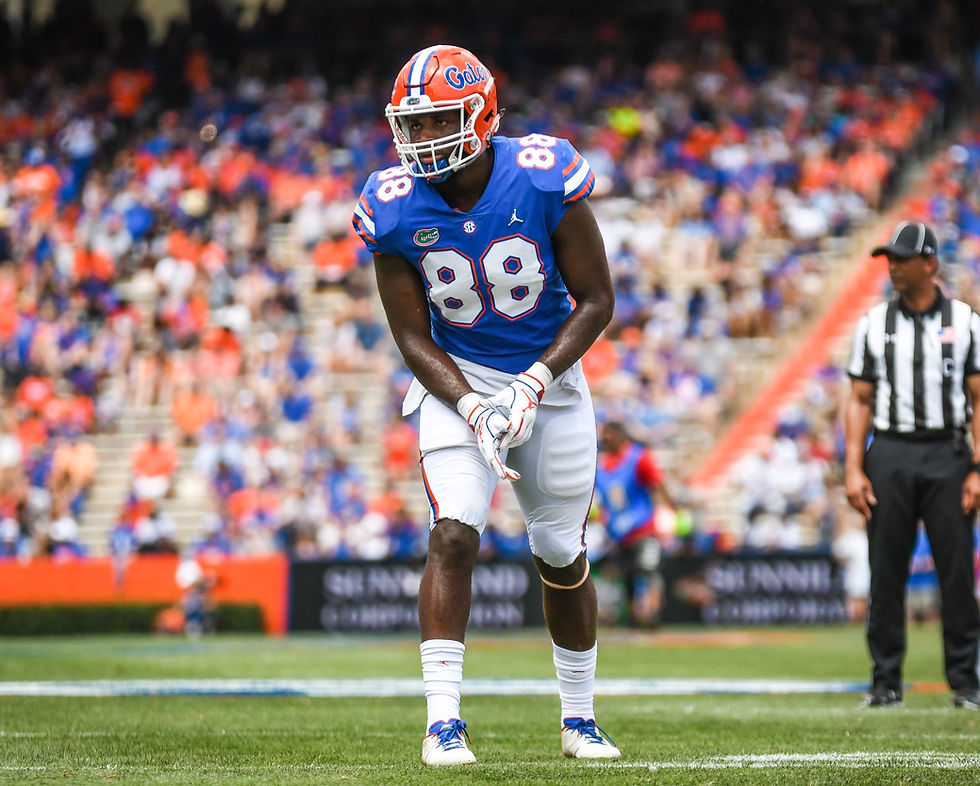
TIGHT ENDS (5)
Kemore Gamble (6-4, 252, RSR): Gamble’s 2020 season was a mixed bag of success – three catches for 51 yards and a TD against Georgia, 3-66, 2 TDs against Vanderbilt – but there were too many dropped passes and poorly run routes along the way. That has to change this year when he will play the role of the traditional tight end in the Florida offense. If he can clean up the receiving issues then he could have a very good year because he’s a very good point of attack blocker. Gamble is a former 4-star recruit out of Miami Southridge where he had offers from Alabama, Miami, LSU, North Carolina and Wisconsin.
Keon Zipperer (6-3, 240, JR): Zipperer most likely becomes the chief receiving target among the tight ends in the fall. He is versatile enough to play out wide, in the slot, as an H-back or in a traditional hand in the turf role. He is a physical mismatch for most safeties due to his size and strength and a speed mismatch for most linebackers. A precise route runner, he has very good hands and the ability to pick up yards after the catch. In 2020, Zipperer caught 11 passes for 145 yards and two touchdowns with a 3-47 game (two touchdown catches) against Arkansas. Zipperer is a former 4-star recruit out of Lakeland High School, where he helped lead the Dreadnaughts to the 2018 state championship. Zipperer chose the Gators over offers from Alabama, Clemson, Georgia, LSU, Oklahoma and Ohio State.
Jonathan Odom (6-6, 240, RFR): The son of former Gator All-American left tackle Jason Odom and a former 3-star recruit out of Tampa Jesuit who had offers from Alabama, LSU, FSU, Michigan and Ohio State, Jonathan took a redshirt in 2020 and added 10 pounds to his frame. He still has some growing to do and is expected to top out at about 250-255. Odom and Kemore Gamble will probably fill more of the traditional tight end role in the fall with Odom probably getting most of his work on special teams.
Nick Elksnis (6-6, 237, FR): Observers who saw him this spring believe Elksnis could be the next great Florida tight end. He is a long strider with deceptive speed. He has excellent hands, runs fluid routes and knows how to get open. In an abbreviated 2020 high school schedule due to COVID-19, Elksnis caught 21 passes for 425 yards (20.2 per catch) and five touchdowns. As a junior he caught 36 passes for 665 yards (18.5) for 12 touchdowns. His high school head coach was former Jacksonville Jaguars quarterback Mark Brunell. A 3-star recruit, Elksnis had offers from Miami, Florida State, Michigan and Ohio State among others.
Gage Wilcox (6-4, 228, FR): A 4-star recruit out of Tampa Jefferson, Wilcox chose the Gators over offers from Alabama, Georgia, Ohio State, Miami and FSU among others. He caught 34 passes for 390 yards and nine touchdowns in 20 high school games. He is a strong runner after the catch. Gage’s future is most likely as a traditional hand in the turf tight end which means he probably takes a redshirt season in 2021 while filling out his frame. He should easily carry 250-260 pounds.
ASSESSING THE TIGHT ENDS There is no unicorn this year. Kyle Pitts has taken his unique skill set and superstar abilities to the NFL where he is the highest drafted tight end in history. To compensate for his loss, Dan Mullen is going to have to use a position by committee approach and even that isn’t likely to put up the kind of numbers (43-770, 12 TDs) that Pitts produced in 2020. The situation is not exactly hopeless, however, as Mullen and tight ends coach Tim Brewster have two experienced tight ends to work with and an intriguing freshman whose spring reviews borderlined on rave.
While Pitts was driving opposing defensive coordinators crazy the way Mullen was lining him up and using him in the passing game, Kemore Gamble was Florida’s blocking tight end and occasional target. He had a better year blocking than he did catching the ball, but he showed enough in the passing game to lend hope that he can put up solid numbers in 2021. Keon Zipperer isn’t as explosive or freakishly athletic as Pitts but he’s quite versatile and can line up in a variety of ways. He’s proven in his first two years at UF that he can be a very reliable receiver. With Pitts gone, he figures to be on the target end far more often.
The new kid on the block is Nick Elksnis, who is fast, athletic and can make all the catches. He runs great routes so the receiving part of the game shouldn’t be a great challenge. It’s the blocking that he will have to work on since he will be going against bigger, stronger and tougher people than he ever saw at Jacksonville Episcopal. He’s a fast learner, however, and expectations are that he will be on the field early and often.
At least for now, there is no superstar tight end but that doesn’t mean the position will lack in productivity. It simply means Mullen will have to be creative in the ways he uses the three guys who figure to be in the rotation.
ASSESSING THE RECEIVERS
In its preseason football magazine, Athlon rated Florida’s tight ends and wide receivers the third best unit in the Southeastern Conference. Lindy’s had the Gators ranked three spots lower. If you go on name recognition, then the Lindy’s assessment is probably correct, but if you go by the combination of talent and coaching then Athlon is on the money.
When you evaluate Florida at the receiver positions you first have to recognize the quality of coaching the Gators get from Tim Brewster and Billy Gonzales. Brewster has produced two Mackey Award winners – one at Florida State and Pitts – and Gonzales has had five of his receivers taken in the NFL Draft since 2019. That kind of track record bodes well for success in 2021.
The Florida offense will be more balanced in 2021 than it has been the last two seasons so the Gators aren’t going to be throwing from the moment the bus comes to a complete stop in front of Ben Hill Griffin Stadium two hours before game time, but the Gators will throw and they will throw successfully. There are very good players who simply need a chance to get the football in their hands to prove themselves.


Comments