Thoughts of the Day: July 30, 2026


A few thoughts to jump start your Thursday morning:
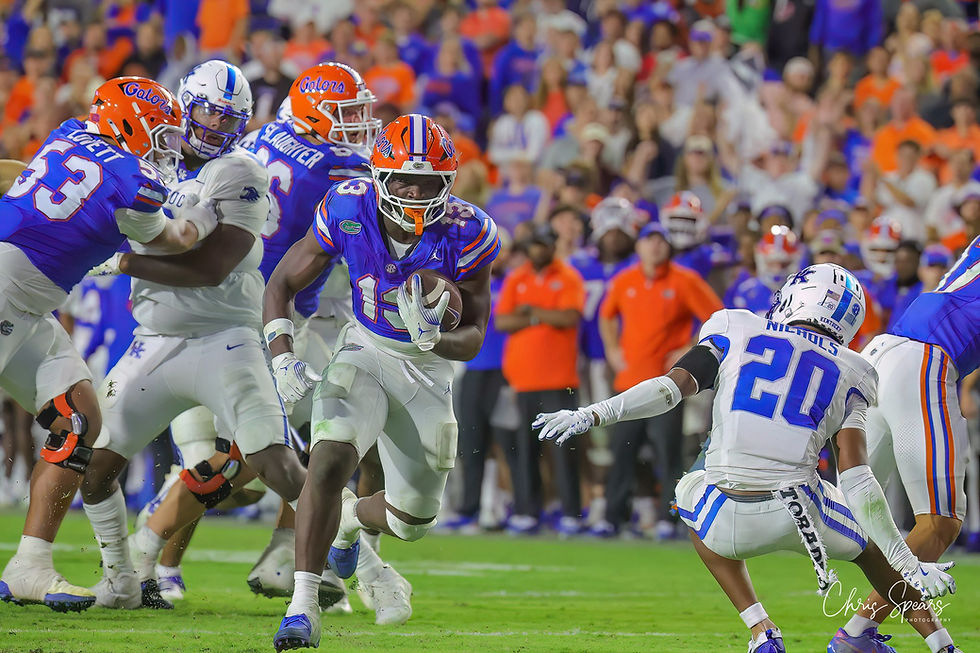
Success on defense during the two most successful eras of Florida football – the Steve Spurrier years from 1990-2001 and Urban Meyer years from 2005-10 – began with the concept of stuffing the run to force opponents into a one-dimensional game. Never has there been a better example than the 41-14 national championship game win over Ohio State in 2006. Against Florida’s five-man defensive line rotation (Jarvis Moss, Derrick Harvey, Ray McDonald, Joe Cohen and Steven Harris) the Buckeyes couldn’t run the football (47 net yards). Without the threat of the run, Heisman Trophy QB Troy Smith was only 4-14 throwing the ball for 35 yards. Harvey and Moss sacked him five times.
During the 12 Spurrier years, the worst defense against the run was 2000 when the Gators gave up 133.1 yards. In six of the seasons, opponents averaged fewer than 90.8 yards on the ground. During Meyer’s six years, the Gators posted three seasons allowing 99.8 or fewer yards and only one (2010, 133.6 yards allowed) in which opponents ran for more than 105 yards.
Spurrier went 122-27-1 with six SEC titles and one national championship. Meyer went 65-15 with two SEC and two national titles.
In the 15 years since Meyer, the Gators have had only one season (2012, 94.9 yards) in which they have allowed fewer than 100 yards per game. Only one other time in the last 15 years (2019, 104.6 yards allowed) have the Gators held opponents to fewer than 128.6 rushing yards per game. The best of Billy Napier’s defenses was 2024 when the Gators held opponents to 149.5 per game.
There is a real correlation between stuffing the run and winning. The Gators are 110-79 in the last 15 years with no SEC titles and just three appearances (all losses) in the SEC Championship Game. The constant has been the inconsistency of the run defense.
For the Gators to regain their status as one of the elite football programs not just in the Southeastern Conference but the entire country, Jon Sumrall has to make stuffing the run his first priority on defense. In three of his four seasons as a head coach, his teams have finished in the top 30 nationally against the run. The best the Gators have done in those same four years was 2024 (149.5 per game).
FLORIDA FOOTBALL VALUED AT $1.16 BILLION
The Athletic placed a value on all power conference teams plus Nore Dame. As expected, Texas was the highest ranked program, one of five from the Southeastern Conference to crack the top ten. Florida ranked 12th, a full $1.3 billion behind the Longhorns. The Big Ten placed 13 teams in the top 30 of this evaluation with the SEC placing 12. The ACC placed three and the Big 12 one.
Factoring in the formula were brand, conferences, and financial statements by each school.
Top 30 (SEC teams bold face): 1. Texas $2.46b; 2. Ohio State $2.3b; 3. Notre Dame $2.1b; 4. Michigan $2b; 5. Georgia $1.95b; 6. Alabama $1.8b; 7. (tie) Oklahoma and Southern Cal $1.6b; 9. Tennessee $1.57b; 10. Penn State $1.4b; 11. LSU $1.32b; 12. FLORIDA $1.16b; 13. Oregon $1.13b; 14. Auburn $1.11b; 15. (tie) Nebraska and Washington $1.06b; 17. Texas A&M $1.05b; 18. Miami $950m; 19. Wisconsin $922m; 20. Florida State $819m; 21. Iowa $806m; 22. Indiana $696m; 23. Arkansas $690m; 24. Michigan State $668m; 25. Clemson $674m; 26. Utah $638m; 27. Ole Miss $638m; 28. Minnesota $629m; 29. South Carolina $597m; 30. Illinois $568m
Other SEC schools: 34. Missouri $500m; 40. Kentucky $400m; 59. Vanderbilt $250m; 60. Mississippi State $248m
BARRING A MIRACLE, THE PROTECT COLLEGE SPORTS ACT IS DEAD FOR NOW
Today is the deadline for the SEC and Big Ten to come to some sort of an agreement that will allow the Protect College Sports Act to move forward in the Senate. As of Wednesday night there was nothing to indicate that the two conferences have reconciled their differences with the bill in its current state. Even with the support of the SEC and Big Ten, it would be a rush to get this bill to a vote on the Senate floor before the August 7 recess.
If the bill can’t get to the Senate floor prior to the recess, the earliest it will be debated and voted on is September. Even then the window to get the bill passed is open briefly. With midterm elections pending the first Tuesday in November, nothing of significance is going to take place in October. Essentially, barring a miracle of walking on water proportions, the Protect College Sports Act is months from being enacted.
In other words, the current wild, wild west culture will continue indefinitely.
MEANWHILE, THE NCAA DOING ITS FORREST GUMP …
The NCAA just did a Forrest Gump – “Stupid is as stupid does” – when it suspended Tennessee linebacker Arion Carter two games for a $427 flight that was paid for by an agent. At the time of the flight, Carter was considering the NFL Draft, but he was injured in a workout, decided to stay in school and returned to Knoxville. The $427 was repaid and the agent was subsequently fired.
No big deal so you would think in light of the out of control climate of college sports. Certainly, the NCAA, in its infinite wisdom, has far greater issues to deal with than a no harm, no foul $427 flight. Right? Well, wrong. The NCAA claims this is an improper benefit. How could that be when we have kids getting $2 million NIL deals before they have even strapped on a jock to play their senior season in high school?
Rather than take on a high profile case that involves thousands upon thousands of dollars, the NCAA chose to assert its authority in a case in which there was no measurable gain. The NCAA already has serious perception issues. Choosing to flex its muscles over $427 that was paid back only makes the NCAA look like a mean teacher at Romper Room.
OLE MISS SUES TWO FORMER PLAYERS WHO TRANSFERRED TO LSU
Ole Miss has filed a breach of contract lawsuit against former players Princely Umanmielen and Devin Harper, who followed Lane Kiffin to LSU. Umanmielen and Harper signed contracts with Ole Miss that included buyouts, then broke the contracts within 90 days, transferred to LSU and signed new deals. Ole Miss is suing the two for buyout money, a case it will probably win.
Until there is legislation in place that regulates the transfer portal schools have very few options to protect their rosters. Enforceable contracts with buyout clauses do offer a measure of protection but there are no guarantees of success in court.
ONE FINAL PITHY THOUGHT: You can’t blame Big Ten commissioner Tony Petiti for taking his shots at the Southeastern Conference. Three straight national championships by Michigan, Ohio State and Indiana have earned him that right. It’s like the late, great Dizzy Dean once said, “It ain’t braggin’ if you can back it up” and right now the Big Ten can back it up.
Petiti isn’t the only one railing on the SEC. Bret Bielema, the Illinois coach who was such a disaster when he piloted Arkansas (29-34 overall, 11-29 SEC in five years) told the folks at Big Ten Media Days that the “SEC wants to live in 2005 forever.” Nico Iamalaeava, touted to be the second coming of Peyton Manning by the Tennessee faithful but now toiling at UCLA, even got into the act with an offhand challenge to the notion that the SEC is better top to bottom because there are no easy weeks. He said, “I think there’s definitely a lot of tough SEC teams that every week it’s going to be a game, but I feel the same way in the Big Ten. Yeah, I think strength of schedule can matter at times, but I think we all pretty much have similar strengths of schedule.” Translation: Our schedules are every bit as tough as yours.”
In Tampa last week, SEC commissioner Greg Sankey offered five College Football Playoff teams from the league in 2025 as proof the league is not in a state of decline. Sankey reeled off impressive numbers such as the SEC leading every league on the planet in any sport in attendance per game (80,000) and the SEC claiming 40 percent of the television viewership for all four of the power conferences.
Those 13 SEC national championship teams since Florida kicked Ohio State to the curb, 41-14, in 2006 matter not to the Big Ten, which is using Big Ten Media Days as a what have you done for me lately platform. SEC purists can talk all they want about how these things go in cycles but the folks from the Big Ten were saying the same thing about the SEC during that remarkable run of seven straight from 2006-12. For the SEC to reclaim bragging rights it has to stop the Big Ten cycle in its tracks starting this year, which is easier said than done.
“The SEC is not the best until it wins the title again,” Paul Finebaum said Wednesday on ESPN.
A week ago, Mr. College Football Tony Barnhart, said he sees the SEC with a lot of good teams but questioned are one or two great teams? That’s a fair question. Texas has assembled a roster that seems capable of running the CFP table and as long as Kirby Smart is the coach at Georgia, the Bulldogs will likely be on everyone’s short list as a potential national champ. Oklahoma, Ole Miss, Texas A&M, LSU and Alabama look good on paper but are any of them as good as Texas or Georgia? Can any of them – Texas and Georgia included – make the leap from good to great?
The only way the SEC is going to stick a sock in the mouth of its many Big Ten critics is for one or more of its teams to prove it on the field by navigating through the College Football Playoff field to win it all. Until that happens, talk of SEC superiority is meaningless.


Comments