Transcript: Florida Gators Quarterback Coach Garrick McGee On Emory Jones, Play Calling and Growing

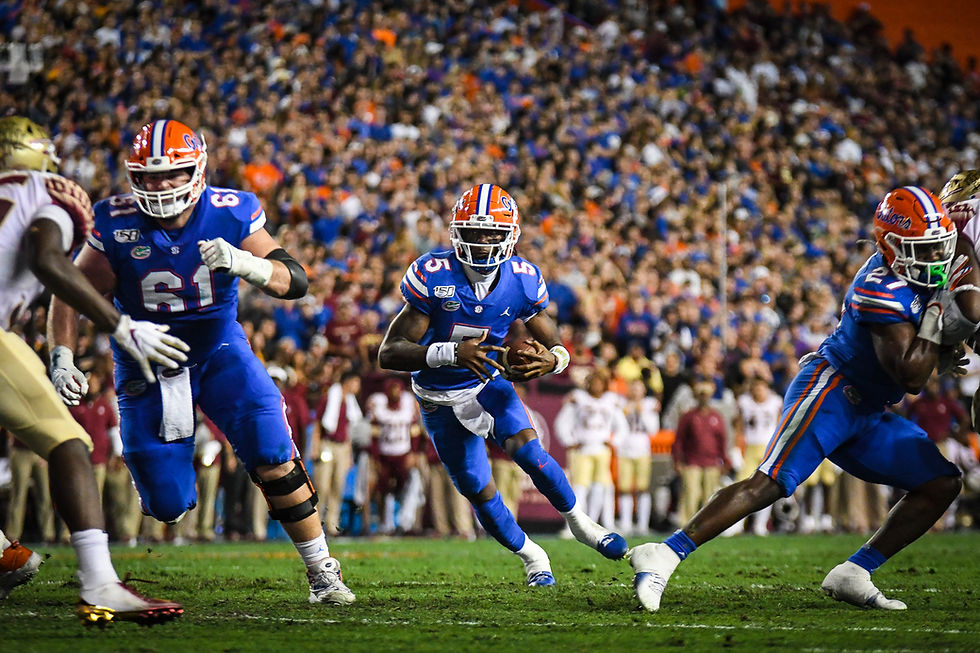
Florida Gators Quarterback coach Garrick McGee met with local media on Thursday for the first time since being hired to replace Brian Johnson. McGee touched on Emory Jones, his coaching philosophy and the QB battle.
As a valued GatorBait Magazine subscriber we are offering this transcript in full.
Who were your influences on your offensive philosophy?
“Well, I’ve been really fortunate. My dad is probably the biggest influence that I had. A lot of people know: my dad was a high school coach in Tulsa, Oklahoma, at Booker T. Washington High School. He’s a guy that took a lot of pride in the way that we go about playing football. It wasn’t necessarily about the plays that we’re running. It was how we go about executing those plays, fundamentally sound, hard, with a lot of pride in it. That’s the biggest influence that I’ve had. It’s not about the plays. The technology’s moving. There’s people playing fast-break offense, there’s people having success running option offense. It’s all about how you go about running those plays and you being fundamentally sound and playing with the proper intensity level.”
What are essential traits to being a successful QB?
“Well, at this level, if you’re going to have a chance to be great, it starts with leadership. Your team needs to say to themselves, ‘We have a chance of winning because we have this particular guy on our team.’ And you build throughout the offseason and spring ball and in the weight room. Your guys go, ‘We got a chance to win any game because this guy’s on our team.’ That’s where it starts. You have to have the ability to be accurate with the football and anticipate things on this level because people are fast that we’re competing against. You have to have the ability to manage a lot of information in your head and know how to process that information. What I mean by that is the situations that come up in football, meaning it’s first and second down, it can be third-and-short, third-and-medium, third-and-long, red zone, 2-minute drill before half, 2-minute at the end of the game. All of these different situations are going to come up and we’re going to have a plan for each situation and you have to be able to have those slotted in your mind and know when to pull from it at each time. So you have to have the ability to manage a lot of information in your mind also.”
See those qualities in Emory Jones?
“Yeah, I think … I talk to those guys about the programs that stay on top and the programs that are built to keep moving forward, they can transition between quarterbacks, meaning we had Kyle here last year, for the last couple years. Kyle did a really good job for the program, almost went after the Heisman Trophy. Well, now he’s going to the NFL and we have to transition from one quarterback to another and the teams that can stay on top and compete at a high level are the ones that can do it. And that’s what we’re pressing for now. We’ve recruited well. We have two guys that are very talented kids, have arm talent, they can run, they understand the system, they have the trust and respect from their teammates. What we have to do is go from being Kyle’s backup to taking control of the team and getting the team to feed off our energy level and the way we go about out business.”
What was your role last year? How did it help you make the transition?
“I joke all the time that I have been on the defensive staff with Todd and Christian and that whole staff, so I know all the defensive players. I wasn’t able to work with them on the field or in the meeting room or anything like that, but you just get to know them when you’re watching their film every day. You’re studying them. You’re studying what they’re doing. And then, I got lucky, and the timing was right for me, and I got blessed and got to be the quarterback coach. So, now, I know all the offensive players and all the offensive coaches also. It’s a really unique deal that I really know all the guys on the team. So, I think the transition for me and the staff was an easy transition because I had been around and I understand how Dan wants to run the program, the expectations of each individual in our building, the culture that he has set up where we all enjoy coming to the office every day and grinding. We know what’s expected of us every day, and I already know that. There was no transition. And I was there at the Cotton Bowl. I was there at the SEC Championship, and I know what we felt like after the game in that locker room, and I know what we all committed to moving into this season, so the transition was simple for us.”
What is the role of an analyst?
“I was one of the guys in the basement watching the film. That’s what I did. What you do is you stay a week ahead. Meaning, if we’re preparing to play Georgia this week, then by the middle of the week on Thursday or Friday, I will transition on to the next program or the next team we’re going to compete against, and I’ll start there on Thursday, Friday, Saturday morning or Saturday night of the game. Then, when we come back Sunday and grade the film, I already have a head start on presenting that team to the defensive coordinator as we move forward. So, I’m trying to buy him more time so that he doesn’t have to look for some stuff. That’s the key to it. And then, as an offensive coach being on defense, if you look at it and you say, ‘Listen, if you show the safety here, they’re probably going to make the call and slide the protection to this side,’ or, ‘This is how the quarterback is going to see this particular coverage’. That’s part of it also.”
Unique to have an offensive coach there.
“Brilliant. I think it’s a brilliant deal.”
Put your own spin on the offense?
“That was an interesting question. I don’t know if you guys realize it, but I was at Toledo working when Coach Mullen was at Bowling Green. And we ended up winning the game that year, but they put up some major numbers on offense. And then, when they left and went to Utah, that same offseason, I left and went to UNLV. So, I was in the same conference with those guys again, and they were undefeated and pretty much unstoppable. Then, they came to Florida. I ended up at Arkansas. And they were winning the national championship and they were rolling. And we thought we were rolling at Arkansas, but they were winning the national championship. And then coach Mullen transitioned to Mississippi State, I was still at Arkansas and we had some battles there. So, I've watched and studied and had a lot of respect for the way that coach has run his offense, and the way he goes about game-planning and scheming. I was fortunate when I was the head coach at UAB, I was able to get my offensive staff with his offensive staff, and we all sit in the same room and shared some ideas and discussed some football ideas. That's kind of how, you know, our relationship ended up connecting. But, what I take pride in is being a quarterback coach, and recruiting great quarterbacks, training them, and ultimately getting them to perform on game day, and while you're doing that, there's a lot that goes on in regards to game planning. You know this staff has been, you know, John Hevesy, Billy Gonzales, Greg Knox, Tim Brewster was at Mississippi State before. I mean, these guys have been together a long time. They know the ins and outs of the offense and know how to manipulate the offense to get it to work versus any kind of defense. You know, so I'm really fortunate to be with them. I've learned the offense, I understand how to get it to work. It was good that I was here last year and got to see some of the practices and see how they go about their business, but we all coach it hard. We got a guy that's one of the best play-callers, best offensive coaches in the building, so he runs it and we get it to go for him."
Any juice left in Oklahoma?
"Well, it's not going to be my bread and butter. We're going to recruit Florida and I have a piece of South Florida. But, I mean, a guy told me a long time ago, I was working for him and he said 'Listen, if your dad's name is Larry McGee and he's from Booker T. Washington High School, you're supposed to be able to go to Tulsa and get some players in here.' So, you know, I still kinda, it's not going to be my bread and butter, but if they have players in that state, or especially in Tulsa, that are good enough to help us win a championship, then I'm going to go after them."
What have you seen from Anthony Richardson so far in camp?
"Um, I love him, he's a great kid, it was good that I was here, you know, so I got to see him and I know their strengths and weaknesses, know their personality. I had never met his mom until we started spring ball this year, so once I got to talk to her, I see where he gets a lot of it, you know, who he is from. But he's just an extremely talented kid, he's still really young. We got fortunate, the only thing you know, good about this COVID is that Anthony ends up with another year, so he's really a true freshman still. And that's, like wow, I can't believe, when I watch him at practice, I'm thinking 'This guy's a true freshman,' you know, it's amazing. But, just think he's an extremely talented kid. He's learning a lot, how fast the game is moving, how you have to throw on time, you have to stay on balance, so I'm just, the future is definitely bright for that kid."
What is the competition like between him and Emory Jones?
"Yeah, well, everybody wants to compete every day. But, to be truthful with you, we all are really, meaning all the quarterbacks, we're trying to just get one-day better, and make sure that we can put somebody on the field that can give our team an opportunity to win the game. And so they, they're best of friends, you know, and we're just trying to get one-day better. Trying to learn something else that's going to help us get another day better. Learn how to execute the offense better, manage the offense, get everybody playing better around them. So, never really talked about any competition, we're just trying to get better so that we can make sure we got somebody on the field that can get our team wins that we need."
What has the growth in analyst positions meant for coaching profession?
“I think that it’s a good role. NFL teams have had that forever. What you’re trying to do is try and have more guys in the building to study, because you’re looking for that one advantage, looking for that one percent that you have over the other team that you’re competing with. Then it gives you a chance to see other guys and get to know the personalities of other guys. It’s really helping people build their networking banks. Paul Pasqualoni he’s the other analyst, he was the other analyst, we were together last year, offense and defense. Coach P was the head coach at Syracuse when I played my first game for Oklahoma and we beat him that game. We all talked about that and I didn’t know that. We were talking and we kept coming together and he said, ‘were you the quarterback in that game?’, and I said ‘yes sir, I sure was’. Now, me and Coach P are connected because of the analyst position that was opened up for the both of us. So I think it really helps with relationships.”
What about the two-year stint in Birmingham teach you about being in the bosses chair at a program like that?
“That it’s a lot that goes on at that position. When you’re the head coach, it’s about managing people. It’s about motivating people. Not just the players, but everybody in your program and getting everybody connected. I really learned a lot, like on the job training for me. Then I was really fortunate to get to watch Coach Mullen do it here at a really high level. His ability to multitask and just offense… I was telling someone earlier about his ability to coach special teams is something that has really blown me away, the details, the knowledge of the angles, just every detail that goes along with special teams. He’s on it just like he is on offense. It’s really incredible being with him and watching him multitask and run a program like this every day.”
Being an analyst and now fulltime gig, are you moved into a house now?
“That’s exactly what I did. I went from apartment living to buying a house. That’s right, and it’s been great.”
How many times do you get asked about Lamar Jackson in the course of a week and what it was like coaching him?
“It was great. It’s always good when you’ve got a really good player that you coach. You tend to coach better when you gotta great player that you coach. That’s kind of how that works out. Lamar is one of the best teammates and the best people and one of the most humble kids that you’re ever going to see. That’s why people… his teammates love him. He doesn’t even realize how good he is because he’s been Lamar his whole life. He’s just a wonderful kid to be around.”
What caught your attention from your time working with Todd Grantham?
“That’s right. When those guys are playing, and, you know, the practice sessions here in spring ball, you can tell there’s a whole ’nother level of intensity on the field with those guys. In my opinion, what separates him is his ability to understand offensive protections. You know, a lot of defensive coaches, they understand defense. Todd understands protection schemes. Todd understands blocking schemes, and that’s how he’s able to produce so many negative-yardage plays. He doesn’t just send his guys forward and go attack the quarterback. He understands the protection schemes and builds things to attack the protection scheme. And when those guys are really on it, intense and playing hard, it’s pretty hard to move the ball on those guys. Because I was with them last year and I know Zach and I know Ventrell and Mohamoud and all those guys, and I’m watching them now, and they’re a little more intense than they were.”
What will the play calling balance look like between you and Mullen? Have you discussed it?
“No. Because I’ve worked with other coaches that were head coach play-callers, and my theory is that, when you’re trying to win the national championship, the best person in the building to do a particular job should do that job. And, I mean, like, I should not play quarterback because I’m not the best quarterback in the building. That’s Emory right now. Dan’s one of the best play-callers in college football. So, in my opinion, if we’re wanting to win a national championship, the best guy at calling plays in the building should call the plays. That’s how I see it because I want to win.”
What are some things that you’ve learned from your players that you keep with you?
“I was on the phone with Ryan Mallett one time, he was playing for the Patriots, he was backing up Tom Brady at the time, and we were talking about third down defense because, you know, first and second down is pretty basic. You get to third down, it gets exotic. And I said to him, ‘Let’s talk about protections in third down.’ And the first thing he said was, ‘Well, the first thing they got to do is they got to get you to third down.’ Now that is a powerful statement right there. That’s something, like, you can go down the field and get six yards on first down and six yards on second down, and you haven’t got to third down yet. So, it’s about managing the first and second down to get yourself either out of third down or in a manageable third down. That’s when – I call it reverse mentoring. He taught me something that obviously Coach Belichick had taught him, and it makes a lot of sense to me.”


Comments